THAW-VLA

Think Like a World Model, Act Like a VLA

Distilling world-model representations into compact robot policies

Trung Dao1, Sankalp Yamsani2, Jaden Park1, Joohyung Kim2, Yong Jae Lee1

1University of Wisconsin–Madison   2University of Illinois Urbana–Champaign

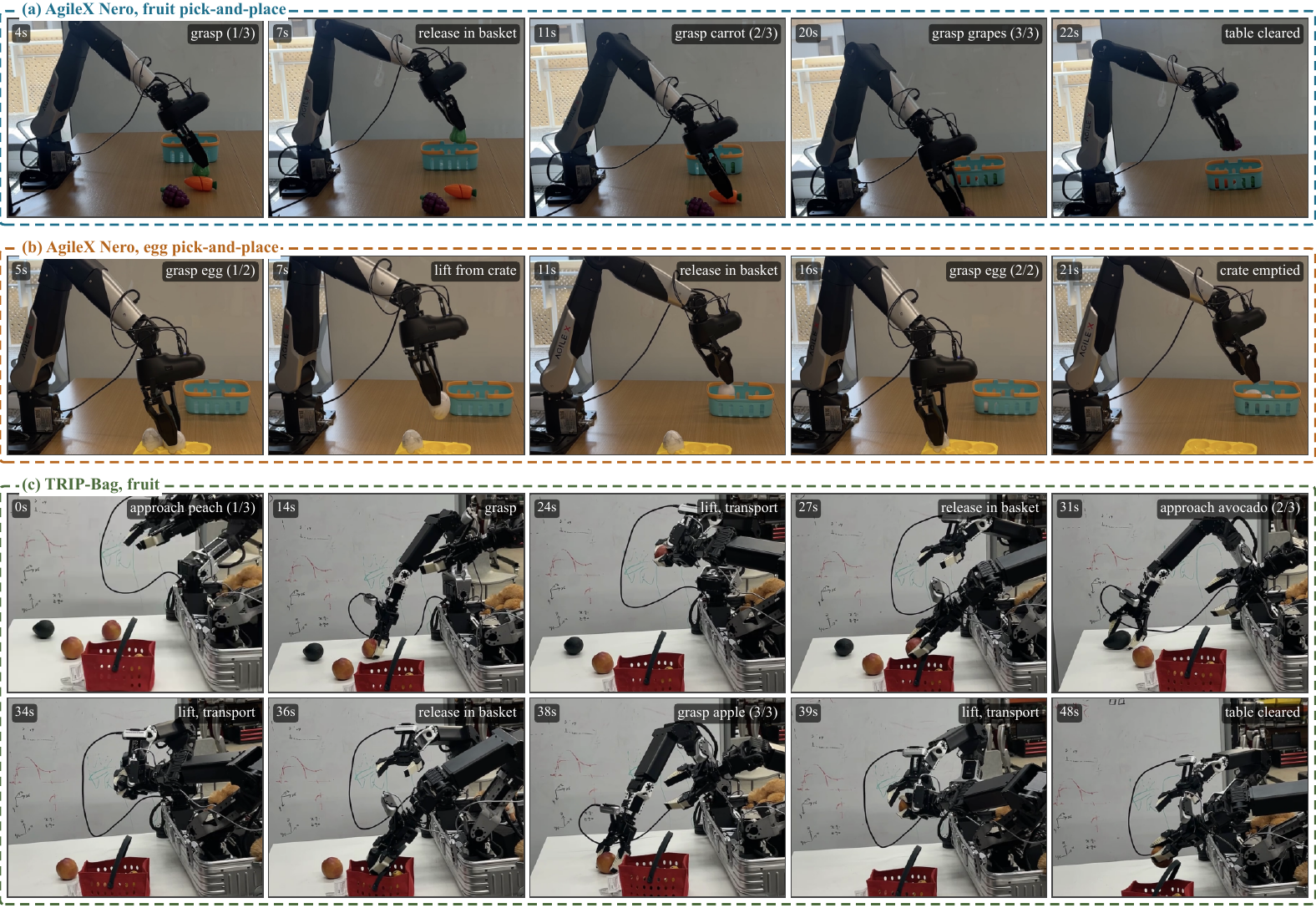
Real-robot rollouts of THAW-VLA (0.8B) on an AgileX Nero (single arm, fruit and egg pick-and-place) and on TRIP-Bag (bimanual fruit handover). Inference runs on a single RTX 5090.

The student, THAW-VLA

A Qwen3-VL backbone with a flow-matching action expert, aligned once to a frozen world model's features and unchanged at deployment.

0.8Bparameters
32 msper inference, RTX 5090
1.86 GBGPU memory
LIBERO
97.9% mean success, up from 95.3%
RoboCasa-GR1
50.5%, up from 48.2%, within 4.3 points of the 4B model
Real robot
66.7% mean over three tasks, up from 56.7%, near 4B π0.5 at 72.2%
Graph
identical to the undistilled baseline, same four flow steps

Abstract

Vision-Language-Action (VLA) models map observations to actions with no objective that accounts for how the world responds, so their robustness is bounded primarily by data coverage. World models carry precisely that missing objective and are better grounded for it, yet rolling the future forward costs seconds per decision and rules them out of the control loop. We show the two can be separated. What a world model knows about physical scenes lives in its internal features; generating the future is merely the objective that produced them, so the grounding can be inherited while the generative machinery is left behind.

We add one feature-alignment term to ordinary VLA training: a frozen world model is run over the training frames once and cached, and the student learns to agree with that cache. No teacher is loaded during training, the projector is discarded after it, and the deployed policy is identical to the undistilled baseline, running in 32 ms and 1.86 GB on a consumer RTX 5090, so every gain is attributable to the representation rather than to added capacity or test-time compute. A 0.8B student reaches 97.9% on LIBERO, improves from 48.2% to 50.5% on RoboCasa-GR1 humanoid manipulation, and the same objective carries over to real hardware, on both a single-arm and a bimanual platform. The gain survives changes of student scale, backbone, alignment layer, and teacher, indicating a broad representational prior rather than a fragile alignment between two particular networks.

A small policy at the accuracy of a large one
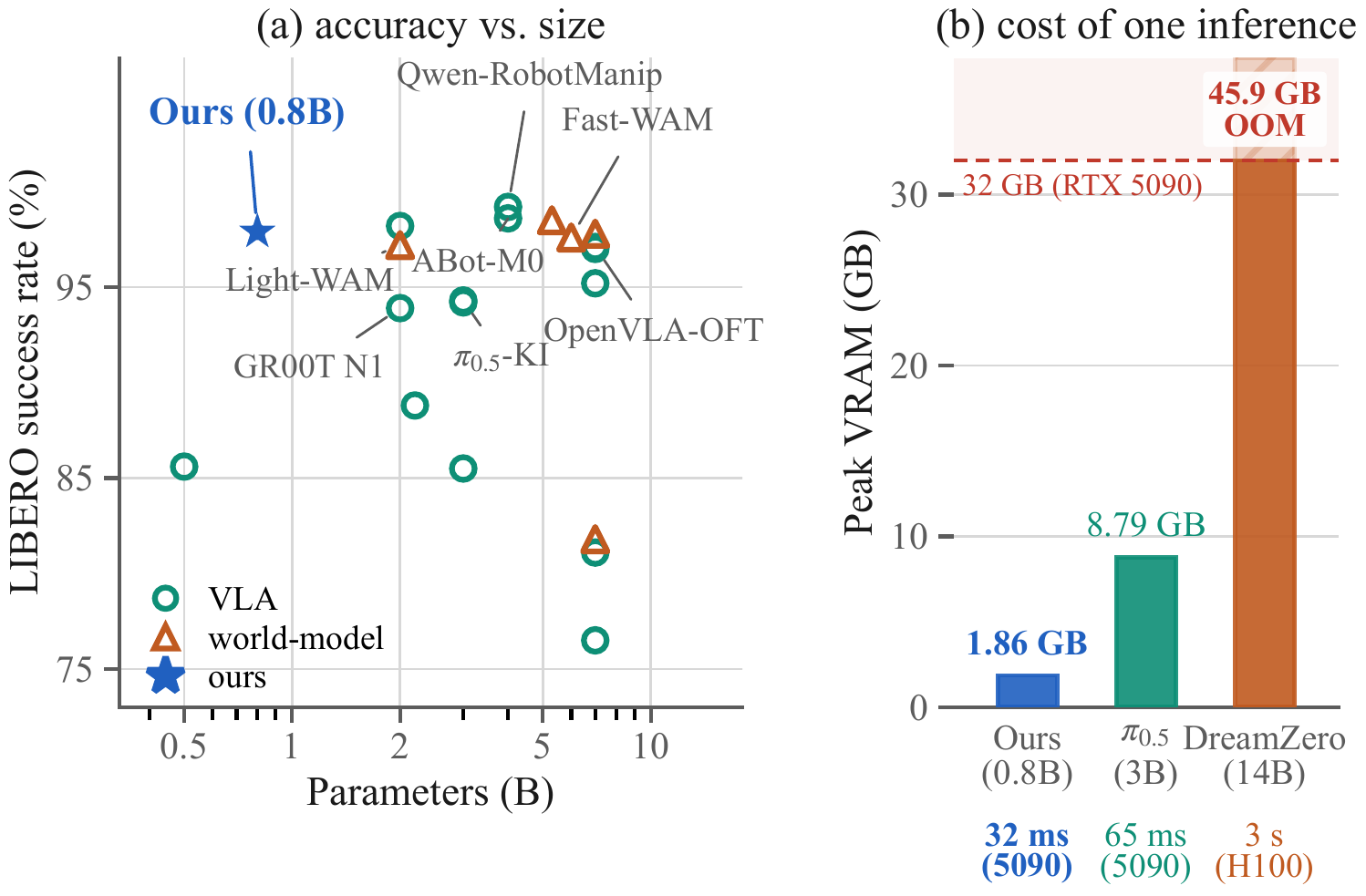
Left: LIBERO mean success rate against parameter count, with our 0.8B policy near the top-left. Right: per-inference latency and memory for DreamZero, pi-0.5, and ours, against the 32 GB of an RTX 5090.
(a) LIBERO four-suite mean success rate against parameter count. (b) What one inference costs, against the 32 GB of a consumer RTX 5090. World-model policies such as DreamZero are grounded but need seconds and 45.9 GB per decision; THAW-VLA at 0.8B answers in 32 ms and 1.86 GB.

Method

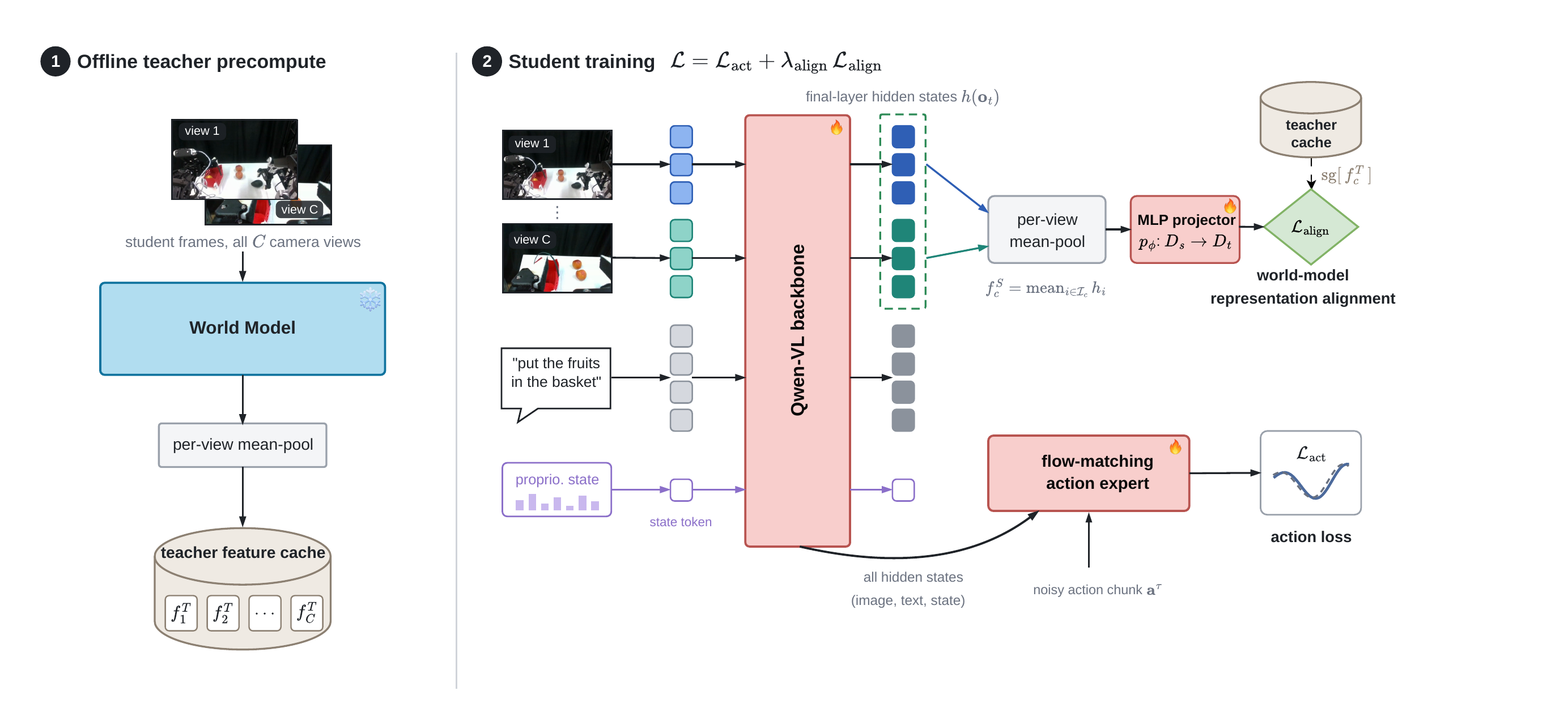
System overview. Left: offline teacher precompute with a frozen world model producing per-view features. Right: student training with a Qwen3-VL backbone, a flow-matching action expert with the action loss, and a per-view mean-pool plus MLP projector aligned to the teacher feature by a cosine loss.
Left, the frozen teacher (Cosmos3-Nano) is run once over the training frames; its layer-24 image tokens are mean-pooled per view. Right, the student (Qwen3-VL backbone, flow-matching action expert) trains on the usual action loss plus one cosine loss between its projected pooled image tokens and the teacher's features, weight 0.5. At test time the projector and loss are removed, so the deployed graph is the undistilled student.

Results

The control in every table is the same student trained without the alignment term. Simulation rows for our models are the mean over four evaluation runs (2 seeds × 2 GPUs); real-robot cells are 30 trials each.

LIBERO, success rate (%)Baselines quoted from their papers. Every other policy below 4B lands between 78.7 and 95.3.
MethodSizeSpat.Obj.GoalLongAvg.
VLA policies
OpenVLA7B84.788.479.253.776.5
VLA-OS0.5B87.096.592.766.085.6
SmolVLA2.2B93.094.091.077.088.8
π03B96.898.895.885.294.2
OpenVLA-OFT7B97.698.497.994.597.1
S²-VLA2B98.499.698.496.498.2
Qwen-RobotManip4B99.2
World-model policies
WorldVLA7B87.699.283.460.081.8
Light-WAM2B98.299.697.893.097.2
Fast-WAM6B98.2100.097.095.297.6
LingBot-VA5.3B98.599.697.298.598.5
Ours
QwenGR00T, no distillation0.8B96.6 ±0.996.4 ±1.195.6 ±0.892.6 ±1.495.3 ±0.7
THAW-VLA0.8B99.3 ±0.699.2 ±0.799.4 ±0.593.8 ±1.197.9 ±0.5
RoboCasa-GR1, 24 environmentsHumanoid, single ego camera, 29-D bimanual action space. † re-evaluated by us under the same four-run protocol.
MethodSizeSR (%)
QwenFAST4B39.0
QwenPI4B43.9
Isaac-GR00T N1.63B47.6
Isaac-GR00T N1.53B48.2
QwenOFT4B48.8
LangForce4B52.6
QwenGR00T†4B54.8 ±2.0
ABot-M04B58.3
PhysBrain4B64.5
ACE-Ego-04B72.8
QwenGR00T, no distillation0.8B48.2 ±2.1
THAW-VLA0.8B50.5 ±2.3
Real robot, success rate (%)30 trials per cell. Fruit and egg pick-and-place on the AgileX Nero; bimanual fruit handover into a bag on TRIP-Bag.
PolicyParamsFruitEggFruit, 2-arm
π0.54B93.370.053.3
QwenGR00T, no distillation0.8B83.346.740.0
THAW-VLA0.8B93.360.046.7
Filmstrips of successful rollouts: fruit pick-and-place and egg pick-and-place on the AgileX Nero, and bimanual fruit handover on TRIP-Bag.
Successful rollouts of THAW-VLA (0.8B), third-person camera. (a) fruit and (b) egg pick-and-place on the AgileX Nero; (c) the fruit handover on TRIP-Bag. Remaining failures are errors of placement, not recognition: the policy finds the right object and misses the last few centimetres.

Ablations: the recipe survives its own design choices

Student and layer ablations on RoboCasa-GR1 (single A100 run); teacher ablation on LIBERO.

TeacherThree world models that differ in objective, architecture, and width. All three lift the same student.
TeacherFamilySizeRead atDtLIBERO
none (control)95.3 ±0.7
V-JEPA2-ACenc.–predictor1.3Bpredictor norm102496.5 ±0.3
Fast-WAMvideo DiT5BDiT layer 15/30307296.9 ±0.8
Cosmos3-Nanoomnimodal VLM8BLM layer 24409697.9 ±0.5
Student scale and backboneSame recipe, no code change: the projector sizes itself to the student width.
BackboneParamsw/owithΔ
Qwen3.5-VL0.8B50.352.8+2.5
InternVL1B50.953.3+2.4
Qwen3-VL4B56.858.4+1.6
Which student layer to alignQuarter-length schedule, so only the ordering is meaningful. Every layer trains stably.
LayerDepthSR (%)
L81/347.5
L121/249.4
L162/345.9
L24 (final)full49.8

Citation

@article{dao2026thawvla,
  title  = {{THAW-VLA}: Think Like a World Model, Act Like a VLA: Distilling World-Model Representations into Compact Robot Policies},
  author = {Dao, Trung and Yamsani, Sankalp and Park, Jaden and Kim, Joohyung and Lee, Yong Jae},
  year   = {2026},
  note   = {Under review}
}